
Mole Removal in Richmond Hill Directory
Mole Removal in Richmond Hill: Costs, OHIP and Safe Options.
Thinking about mole removal in Richmond Hill? This guide explains when OHIP pays and when removal is cosmetic, 2026 private prices by method, why a physician should examine a mole before anything is removed, how shave, laser and surgical removal compare, and what healing looks like, with options from Oak Ridges to Highway 7.
- Clinics offering it
- 1
- Reviews from
- Data refresh
- Weekly
Top-Rated Mole Removal providers in Richmond Hill.
1 clinics
Richmond Hill Guide
Mole removal in Richmond Hill at a glance
- Typical price for cosmetic removal: about $150 to $600 per mole, more for larger or facial lesions needing stitches; add 13% HST
- OHIP: covers assessment and removal when a mole is medically suspicious; purely cosmetic removal is paid out of pocket
- Methods: shave removal, punch or surgical excision, and laser or electrocautery for some benign spots
- Who should do it: a physician, ideally after a dermatoscope exam; tissue should go to a lab when there is any doubt
- Healing: 1 to 3 weeks for most sites, with a pink mark that fades over several months
People in Richmond Hill book mole removal for two very different reasons. Some want a raised mole gone because it catches on a bra strap, gets nicked when shaving or simply bothers them in photos. Others have noticed a spot changing and want it out. The first is a cosmetic choice. The second is a medical question that needs a diagnosis before anything is removed, and mixing the two up is where people get into trouble.
Check first, remove second
Most moles are harmless. Still, melanoma can start in an existing mole or look like a new one, and it is far easier to treat early. Before any cosmetic removal, a physician should look at the spot, ideally with a dermatoscope, a lighted magnifier that shows pigment patterns invisible to the naked eye. The old ABCDE checklist is a decent home screen:
- Asymmetry: one half does not match the other.
- Border: ragged, notched or blurred edges.
- Colour: several shades of brown, black, red, white or blue in one spot.
- Diameter: larger than about 6 mm, the size of a pencil eraser, though melanomas can be smaller.
- Evolving: any change in size, shape, colour, height, or new itching or bleeding.
A spot that looks different from all your other moles, sometimes called the ugly duckling sign, also deserves a look. The Canadian Dermatology Association has patient information on skin checks and skin cancer. If anything on that list applies, start with your family doctor or a walk in clinic and ask about a referral to a dermatologist, rather than a cosmetic clinic.
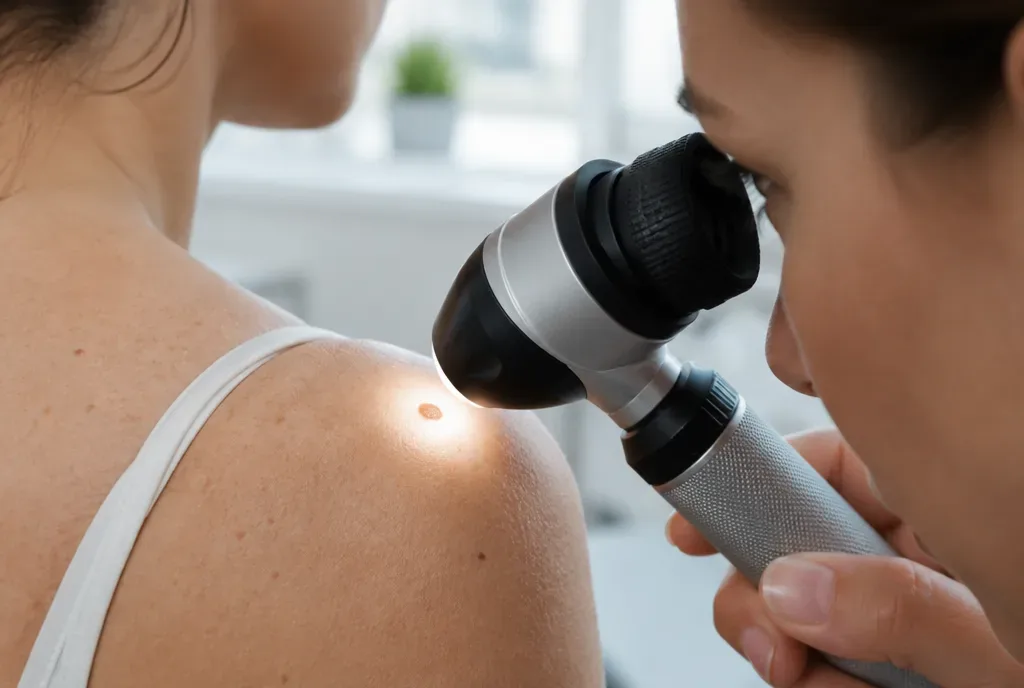
A dermatoscope exam takes a minute or two and is the single most useful step before deciding whether a mole is cosmetic or medical.
Mole removal costs in Richmond Hill
When removal is medically necessary, for example a suspicious lesion your doctor wants biopsied, OHIP generally pays. When a benign mole is removed because you do not like it, Ontario treats that as a non essential cosmetic service and you pay privately. Clinics across Ontario price this per lesion; a Richmond Hill surgical practice lists lipoma and mole removal from about $550, and other Ontario clinics quote from around $495 plus HST for surgical removal, while simpler shave or laser removal of small moles often costs less.
| Method | Best for | Typical private price (CAD, before HST) |
|---|---|---|
| Shave removal | Raised, benign moles on the body or face | $150 to $450 per mole |
| Laser or electrocautery | Small, flat or slightly raised benign spots | $100 to $400 per spot |
| Punch excision | Small moles where a full sample is wanted | $250 to $550 |
| Surgical excision with stitches | Larger or deeper moles, recurrence | $450 to $900+ |
| Pathology lab fee | Sending tissue for analysis | Sometimes included; ask |
Ask whether the quote includes the consultation, the pathology fee and any follow up for stitch removal. Multiple moles in one visit are usually discounted after the first. If a doctor finds something suspicious during a cosmetic consult, the plan should switch to a medical biopsy, and coverage may change with it.
Who should remove a mole in Ontario
Cutting into or below the deeper layers of the skin is a controlled act under Ontario's health professions law, so surgical excision is done by physicians. Dermatologists, plastic surgeons and family physicians with procedural training all remove moles in York Region. You can confirm a doctor's registration and specialty on the CPSO public register.
Some laser and cosmetic clinics advertise mole removal with lasers or radiofrequency devices. That can be reasonable for spots a physician has already confirmed are benign. The problem is that a laser vaporizes the tissue, so nothing is left to send to a lab. If the "mole" was an early melanoma, the chance to diagnose it is gone and pigment can come back in a way that is harder to read later. Our honest view: if a laser clinic offers to remove a mole without a physician examining it first, walk away.
- Who will examine the mole before removal, and are they a physician?
- Will the tissue be sent for pathology, and who calls me with the result?
- Which method do you recommend for this spot, and what scar should I expect?
- What is the plan if the mole grows back?
Where to go in and around Richmond Hill
Dermatology and minor surgery clinics sit along Yonge Street from Oak Ridges down to Highway 7, and several medical buildings near Mackenzie Richmond Hill Hospital host physicians who do lesion removal. Wait times for a publicly funded dermatology referral can be long, which is one reason people go private for clearly benign moles. Markham and Toronto add more choice; you can browse the Markham med spa directory or the Toronto directory, and every Richmond Hill provider is listed on this page and in the Richmond Hill directory.
The procedure and the healing
Most removals take 15 to 30 minutes. The doctor marks the area, injects a little local anaesthetic (the sting of the needle is the worst part), then removes the mole. Shave removals are left to heal with ointment and a bandage. Excisions are closed with a few stitches, which come out after about 5 to 7 days on the face and 10 to 14 days on the body.

Many clinics photograph moles before removal so any change at the site can be compared later.
- Keep the wound clean and covered with petroleum jelly for the first week or two.
- Avoid swimming, hot tubs and heavy exercise that stretches the area until it has closed.
- Protect the healing scar from sun for several months. A summer at Lake Wilcox or on a Richmond Green patio can darken a fresh scar permanently.
- Call the clinic about spreading redness, warmth, pus or fever.
The site stays pink or slightly raised for a few months before it flattens and fades. Shave removal can leave a small white or pink flat spot, and occasionally a few pigment cells regrow at the edge. Excision leaves a thin line, usually longer than the mole itself, because the wound has to be shaped to close neatly.
Risks and things to consider
Mole removal is low risk, but every method leaves some mark. Infection, bleeding, a raised or keloid scar (more common on the chest, shoulders and in deeper skin tones), and recurrence are the main downsides. Tell the doctor about blood thinners, keloid history, diabetes and any allergy to local anaesthetic.
Some spots people call moles are something else: skin tags, seborrheic keratoses, cherry angiomas or sun spots. Several of those respond better to freezing, light electrocautery or an IPL photofacial than to excision, so an accurate diagnosis can save you a scar.
Related links
More Services in Richmond Hill.
From our blog
Tips, guides, and treatment insights.
Explore tips, trends, and insights in wellness from our latest blog posts.


For Businesses
Help people discover your clinic.
Present your services, introduce your team, and keep your clinic information up to date.
Claim your listing