Botox and Dysport both relax the muscles that cause frown lines, forehead lines, and crow's feet, and both last about three to four months. Dysport tends to start working a day sooner and spreads a little more, which suits larger areas. Per treated area, the two usually cost within 10 to 15 percent of each other in 2026, roughly $250 to $520.
If you are choosing your first neuromodulator, the Botox versus Dysport question comes up fast, and most of the advice online fixates on price per unit, which is the one number that will mislead you. Dysport looks far cheaper per unit, but you need more units to get the same result, so the total you pay for a forehead or a set of frown lines lands in nearly the same place. What actually separates the two is onset, spread, and how each one behaves on different parts of the face. This guide walks through all of it with 2026 US pricing, then points you to verified providers so you can compare quotes near you. You can browse Botox clinics and Dysport providers on MedSpaFind as you read.
Botox vs Dysport at a glance (2026)
Both products are botulinum toxin type A. Botox Cosmetic is made by Allergan (now part of AbbVie) and Dysport is made by Galderma under license from Ipsen. Both are FDA approved for moderate to severe glabellar lines, the vertical creases between the brows, and both are used off label across the upper face and elsewhere. The table below is the short version. The sections after it explain what each row means for your face and your bill.
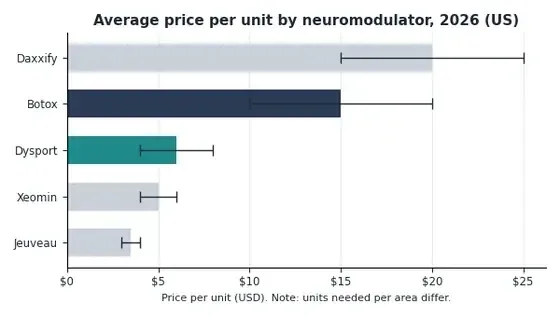 Average price per unit by neuromodulator, 2026 US ranges. Per-unit price alone is misleading because the number of units needed per area is different for each product.
| Factor | Botox | Dysport |
|---|---|---|
| Onset (first visible change) | 3 to 7 days | 1 to 3 days |
| Full result | 10 to 14 days | 7 to 10 days |
| Duration | 3 to 4 months | 3 to 4 months |
| Spread from injection point | More focused | Wider diffusion |
| Unit ratio (vs Botox) | 1 unit | 2.5 to 3 units |
| Price per unit (US 2026) | $10 to $20 | $4 to $8 |
| Typical cost, frown lines | $260 to $450 | $250 to $450 |
| Best suited to | Precise, small muscles | Larger, flatter areas |
The headline is that these are close cousins, not opposites. For most people, a skilled injector can produce an excellent result with either one. The differences matter at the margins, and they matter more for some areas than others.
Onset: how fast you see results
Dysport usually shows up first. Many patients notice softening within 24 to 48 hours, and the full effect settles in around a week. Botox tends to take three to seven days to start, with the final result at about two weeks. If you have an event on Saturday and you are booking on Monday, Dysport buys you a little more margin. If you are planning weeks ahead, the onset gap stops mattering.
One practical note: because Dysport works quickly, some injectors like it for first-time patients who are anxious about whether anything is happening at all. Seeing a change in a day or two is reassuring. Just remember that neither product is fully judged until roughly two weeks in, so resist the urge to ask for more the day after your appointment.
Duration: how long each one lasts
When dosed correctly for your muscle strength, Botox and Dysport last about the same, three to four months for most people in the upper face. Duration depends far more on you than on the brand. Strong muscles, heavy expression, fast metabolism, and lower dosing all shorten the window. Higher, well-placed dosing and treating an area consistently over time tend to extend it.
You will read anecdotes that one lasts longer than the other. In head-to-head studies the difference is small and inconsistent, so it is not a reliable reason to pick one. If longevity is your top priority and you are willing to pay for it, the product to look at is Daxxify, which is formulated to last around six months for some patients, not Botox or Dysport. More on the wider field below.
Spread and precision: where the real difference shows up
This is the one that changes results. Dysport diffuses a bit more from each injection point, so it covers a broad, flat area like the forehead with fewer, more even placements. That wider spread is an advantage on large muscles and a liability near small, precise ones. Around the eyes, the mouth, or the brow, where a millimeter of unwanted spread can drop an eyelid or flatten an expression, many injectors prefer the tighter control of Botox.
None of this is absolute. An experienced injector adjusts dilution, depth, and placement to control spread with either product. The takeaway is that the person holding the syringe matters more than the label on the vial. A board-certified dermatologist, plastic surgeon, or an experienced nurse practitioner or registered nurse who does hundreds of these a year will get you a better outcome with Dysport than a novice will with Botox. When you compare anti-wrinkle injectable providers, weigh the injector's experience above the brand.
The real cost: why per unit is the wrong number
Here is where most comparisons go wrong. Dysport is priced around $4 to $8 per unit and Botox around $10 to $20 per unit, so at a glance Dysport looks like a bargain. The catch is the unit ratio. Dysport units are smaller, and you need roughly 2.5 to 3 of them to match 1 Botox unit. A frown-line treatment that takes 20 units of Botox takes about 50 to 60 units of Dysport. Multiply it out and the totals converge.
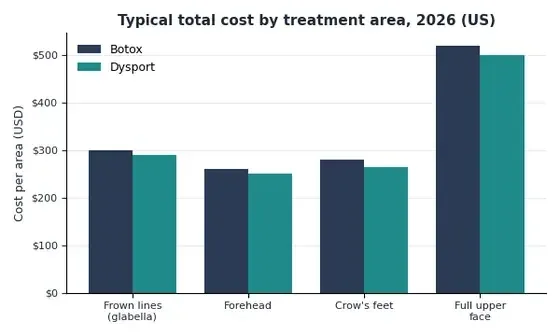 Typical total cost by treatment area, 2026 US. Once you account for the unit ratio, Botox and Dysport land within about 10 to 15 percent of each other per area.
The table below shows the math the way you actually pay it, by area rather than by unit. Botox figures assume about $13 per unit and Dysport about $5 per unit, which are mid-market 2026 rates. Your local numbers will shift with the city and the injector, but the pattern holds almost everywhere.
| Treatment area | Botox units | Botox cost | Dysport units | Dysport cost |
|---|---|---|---|---|
| Frown lines (glabella) | 20 | $260 | 50 | $250 |
| Forehead lines | 15 | $195 | 40 | $200 |
| Crow's feet (both sides) | 20 | $260 | 50 | $250 |
| Full upper face | 40 | $520 | 100 | $500 |
| Lip flip | 5 | $65 | 12 | $60 |
| Masseter (per side) | 25 | $325 | 60 | $300 |
A few things follow from this. First, if a clinic quotes you per unit, always ask how many units they expect to use, because a low per-unit price with a high unit count is not a deal. Second, watch for Dysport promotions that advertise a rock-bottom per-unit rate, since the total can still be high once the unit count is filled in. Third, since the totals are so close, price is rarely the deciding factor between the two. Pick based on the area you are treating and the injector you trust, then compare final quotes. You can see how these numbers move by city in our local guides, such as Botox cost in Miami, Botox cost in Los Angeles, and Botox cost in Austin.
How pricing changes by city
Neuromodulator pricing tracks local cost of living and clinic density. Dense, competitive markets push per-unit rates down, while luxury enclaves and low-competition areas run higher. A frown-line treatment that costs $240 in one metro can be $400 in another for the same number of units. The relationship between Botox and Dysport totals stays roughly even in each city, so the city changes your bill more than the brand does.
| Metro | Botox per unit (2026) | Frown lines, typical total |
|---|---|---|
| Miami, FL | $12 to $16 | $260 to $360 |
| Los Angeles, CA | $12 to $18 | $280 to $400 |
| New York / Manhattan | $14 to $22 | $300 to $450 |
| Las Vegas, NV | $11 to $15 | $240 to $340 |
| Dallas, TX | $11 to $15 | $240 to $340 |
| Scottsdale, AZ | $12 to $16 | $260 to $360 |
| Boston, MA | $13 to $18 | $280 to $400 |
If you want to see local Botox and Dysport providers in your area, browse med spas by city on MedSpaFind: Miami, Los Angeles, Manhattan, Las Vegas, Dallas, Scottsdale, and Boston. Planning treatment in Canada instead? Both products are approved by Health Canada, and you can compare clinics in Toronto and Vancouver, or read our Vancouver Botox cost guide and Toronto Botox guide.
Which one should you choose?
Use the area you are treating as your first filter, then let your injector's preference and experience settle it. The guidance below reflects how most experienced injectors think about the two.
Lean toward Dysport if
You are treating the forehead or another broad, flat area where even coverage helps. You want to see results as fast as possible before an event. You have strong forehead muscles that need wider distribution to soften evenly. You are comfortable with a slightly softer, more spread-out effect.
Lean toward Botox if
You are treating small or delicate areas such as around the eyes, a lip flip, or fine brow shaping where precise placement matters. You want the most predictable, well-studied option with the longest track record. You have had Botox before and liked the result, since switching brands means recalibrating dose. You prefer a more contained effect that stays exactly where it is placed.
Either works well if
You are treating standard frown lines with an experienced injector. In that case both deliver excellent, comparable results, cost about the same, and the choice comes down to your injector's habit and what is stocked that day. Do not overthink it. The quality of the injector will shape your outcome far more than Botox versus Dysport ever will.
Safety, side effects, and downtime
Botox and Dysport have very similar safety profiles, which makes sense given they are both botulinum toxin type A. The common side effects are minor and short-lived: small bruises at injection points, mild swelling, a temporary headache, or brief redness. These usually fade within a day or two, and most people return to work straight after their appointment. There is no meaningful downtime with either product.
The main risks are the same for both and come down to placement, which is another reason the injector matters more than the brand. Toxin that migrates to the wrong muscle can cause a temporary droopy eyelid or an uneven brow. These effects are not permanent, since the product wears off, but they can last weeks, so precise injection technique is worth paying for. Because Dysport spreads a little more, a careless injection near the eye carries slightly more risk of unwanted spread, which is exactly why many injectors reserve Botox for the most delicate areas. Tell your provider about any neuromuscular conditions, pregnancy, or breastfeeding, since neuromodulators are not recommended in those situations.
Aftercare is identical for both. Avoid rubbing the treated area, lying flat, or intense exercise for a few hours, and skip the sauna and heavy alcohol the same day. Following these simple steps lowers the chance of a bruise and keeps the product where your injector placed it.
Can you switch between Botox and Dysport?
Yes, and plenty of patients do. There is no medical reason you cannot have Botox one visit and Dysport the next. The only thing to keep in mind is dosing. Because the unit systems are different, your injector has to recalculate rather than copy your last treatment across, so give it a full two weeks before you judge a switch. Some people find they slightly prefer the feel of one over the other once they have tried both, often based on how a particular area moves afterward.
If you have built a result you love with one product, there is little reason to switch just to chase a lower per-unit price, since the totals are close and switching means recalibrating your dose. But if your current product is not giving you the onset speed or the spread you want in a specific area, trying the other one is reasonable and low risk. An injector who works with both can tell you quickly whether a switch is likely to help.
How Botox and Dysport fit the wider neuromodulator field
Botox and Dysport are the two biggest names, but they are part of a larger group of FDA-approved botulinum toxin type A products, and it helps to know where each sits. Botox still holds the largest share of the US market and the deepest set of approved uses. The others compete mainly on price, onset, or duration.
| Product | Maker | Price per unit (2026) | Notable trait |
|---|---|---|---|
| Botox | Allergan / AbbVie | $10 to $20 | Longest track record, most approved uses |
| Dysport | Galderma / Ipsen | $4 to $8 | Faster onset, wider spread |
| Xeomin | Merz | $4 to $6 | No complexing proteins, a purer formula |
| Jeuveau | Evolus | $3 to $4 | Aesthetic-only, marketed as "Newtox" |
| Daxxify | Revance | $15 to $25 | Longer duration, around 6 months for some |
Xeomin is worth a mention for anyone worried about resistance. It contains no complexing proteins, which in theory lowers the chance of developing antibodies over years of treatment, though this rarely affects cosmetic patients. Jeuveau is priced to compete and is aimed squarely at frown lines and other aesthetic use. Daxxify is the one to consider if you want fewer appointments per year and are willing to pay a premium. For most first-timers, though, the decision realistically comes down to Botox or Dysport, and you can explore all of these under facial injectable services on MedSpaFind.
What to ask before you book
Whichever product you choose, a good consultation protects your result and your wallet. Ask who will be injecting you and what their credentials are, since a physician, nurse practitioner, or experienced registered nurse should plan and perform the treatment. Ask how many units they expect to use so you can calculate the real total rather than react to a low per-unit teaser. Ask whether the quoted price includes any touch-up visit at the two-week mark, which reputable clinics often build in. And ask which product they recommend for your specific area and why, because a thoughtful answer tells you the injector is thinking about your face rather than pushing whatever is on promotion.
It is also worth asking about combining treatments. Many patients pair a neuromodulator with dermal fillers or a lip filler in the same visit, since toxin softens movement lines while filler restores volume, and the two address different signs of aging. A good injector will map out what each product does before you commit to anything.
Compare Botox and Dysport providers near you
Botox and Dysport are close enough that you cannot go wrong on the product alone, so put your energy into finding the right injector at a fair price. MedSpaFind lets you compare verified med spas, injectors, and pricing across the US and Canada in one place, without any single clinic paying to rank above the rest. Start by browsing Botox providers and Dysport providers, explore the full range of anti-wrinkle injectable options, or search every treatment and clinic across the MedSpaFind directory. When you are ready, compare clinics in your city, read what patients actually say, and book with an injector you trust. You can also read more on why some patients choose Dysport for a natural look in our guide on Dysport and natural-looking results, or browse providers across the United States to see who is near you.
Frequently asked questions
Neither is universally better; they solve slightly different problems. Dysport starts working a day or two sooner and spreads more, which suits large, flat areas like the forehead. Botox stays more contained, which many injectors prefer for delicate areas around the eyes or mouth. For standard frown lines, both produce excellent, comparable results, so the injector's skill matters more than the brand.
Not meaningfully. When both are dosed correctly for your muscle strength, they last about three to four months. Head-to-head studies show only small, inconsistent differences, so duration is not a reliable reason to choose one over the other. If you want a longer-lasting result, Daxxify is formulated to last around six months for some patients.
Per unit, yes: Dysport runs about $4 to $8 versus $10 to $20 for Botox in 2026. But Dysport units are smaller, so you need roughly 2.5 to 3 times as many to get the same effect. Once you calculate the total for a treatment area, the two usually land within 10 to 15 percent of each other, often $250 to $520 depending on the area and city.
The conversion is roughly 2.5 to 3 units of Dysport for every 1 unit of Botox. A frown-line treatment of about 20 Botox units typically takes 50 to 60 Dysport units. Because of this ratio, always ask a clinic how many units it plans to use rather than judging by the per-unit price alone.
Dysport. Many patients notice softening within 24 to 48 hours, with the full result at about a week. Botox usually takes three to seven days to start and about two weeks to fully settle. If you are treating close to an event, Dysport's faster onset gives you a little more margin.
Yes, and many patients do. There is no medical reason you cannot alternate between them. The main thing to remember is that the unit systems differ, so your injector recalculates your dose rather than copying your last treatment. Give any switch a full two weeks before judging the result.