Whether CoolSculpting is worth it in 2026 depends on your goals: it delivers a permanent 20% to 25% fat reduction in a treated pinch of stubborn fat for $600 to $1,200 per applicator cycle, and 76% of patients on RealSelf say it was worth the roughly $2,425 they paid. Most people who are close to their goal weight and just want to shift a specific bulge get real, lasting results, while anyone hoping to lose weight or reshape a large area is usually better served by another option. The value comes down to how targeted your fat is, how many cycles you need, and who runs the machine.
CoolSculpting at a Glance (2026)
- Cost per cycle: $600 to $1,200 per applicator, with smaller areas like the chin or arms at $650 to $1,000 per side.
- Typical full treatment plan: $2,000 to $4,500 once you account for multiple cycles and areas.
- Average amount patients actually pay: about $2,425, per RealSelf review data.
- Fat reduction per session: roughly 20% to 25% of fat cells in the treated area, and the destroyed cells do not come back.
- Time to see results: 1 to 3 months, with the fullest result around 3 months.
- Sessions most people need: 1 to 3 cycles per area to reach a visible change.
- Downtime: essentially none, most people return to work the same day.
- Patient satisfaction: 76% "Worth It" on RealSelf across thousands of reviews.
- Rare risk: paradoxical adipose hyperplasia, reported by the manufacturer at about 1 in 3,000 to 4,000 cycles.
How CoolSculpting Compares to Other Fat-Reduction Options
- CoolSculpting (cryolipolysis): freezes and kills fat cells in a targeted pocket without surgery or downtime.
- SculpSure: uses laser heat instead of cold to break down fat, with similar targeting and short sessions.
- Emsculpt and Emsculpt NEO: build muscle and burn some fat with electromagnetic energy, better for toning than debulking.
- Liposuction: a surgical procedure that removes larger volumes of fat in one visit, with anesthesia and recovery.
- Kybella: an injectable that dissolves fat, FDA-approved specifically for the under-chin area.
- GLP-1 medication (semaglutide, tirzepatide): prescription weight-loss drugs that reduce overall body fat, not a spot treatment.
Exact results vary from person to person, since your fat distribution, body area, and how your body clears treated cells all change the outcome. A board-certified dermatologist, plastic surgeon, or trained provider should assess whether you are a good candidate before quoting a plan, because CoolSculpting only suits pinchable, localized fat and does nothing for visceral fat or loose skin. Do not pick a clinic on the lowest per-cycle price alone: applicator selection, the number of cycles, and the operator's experience matter far more to your result than a discounted rate, and a poorly planned treatment can leave uneven contours that cost more to correct.
Key Takeaways
- CoolSculpting is worth it for the right candidate: someone near their goal weight with a specific, pinchable pocket of fat that resists diet and exercise.
- Expect a 20% to 25% fat reduction per treated area, permanent for the cells destroyed, visible within 1 to 3 months.
- Budget $600 to $1,200 per cycle and $2,000 to $4,500 for a realistic full plan, since most areas need more than one cycle.
- It is a body-contouring tool, not a weight-loss treatment, so the scale barely moves even when the mirror changes.
- Side effects are usually mild and short-lived, but paradoxical adipose hyperplasia is a rare risk worth understanding before you book.
- You can compare CoolSculpting providers and browse med spas across the US on MedSpaFind to check credentials and pricing before your consultation.
Is CoolSculpting Worth It?
CoolSculpting is worth it if you are close to your goal weight and want to remove a stubborn, pinchable bulge without surgery, and it is not worth it if your aim is weight loss or reshaping a large area. That single distinction explains most of the happy reviews and most of the disappointed ones. The 76% of RealSelf reviewers who call it worth the money tend to be people who treated a defined area, went in expecting a modest change, and gave it three months to work. The unhappy minority usually wanted the machine to do a job it was never designed for.
The treatment, known medically as cryolipolysis, is FDA-cleared and made by Allergan Aesthetics, part of AbbVie. It works by cooling fat cells to a temperature that kills them while leaving skin, nerves, and muscle intact. Your body then clears the dead cells over several weeks, and the fat reduction in that spot is permanent because those specific cells are gone. What CoolSculpting cannot do is stop the remaining cells from growing if you gain weight, and it cannot tighten loose skin or reach the deep visceral fat around your organs.
So the honest answer to "is it worth it" is that value depends on candidacy. For a targeted lower-belly pooch, love handles, a double chin, or bra-line fat on someone who already eats well and exercises, it delivers a result that diet alone often cannot. For someone with 30 pounds to lose, the money is better spent elsewhere, and a supervised medical weight-loss program will move the needle in a way freezing one bulge never will.
How Much Does CoolSculpting Cost in 2026?
CoolSculpting costs $600 to $1,200 per applicator cycle in 2026, and a full treatment plan usually lands between $2,000 and $4,500. The wide range exists because pricing is built around cycles rather than flat per-area rates. One cycle covers one application of one applicator, and larger areas like the abdomen need two applicators side by side, which doubles the cost of a single visit before you even factor in repeat sessions.
According to RealSelf review data, the average amount patients report paying is about $2,425 across a course of treatment. That figure is a useful anchor because it reflects what real people spend to finish a plan, not the teaser price for a single cycle that clinics often advertise. When you compare quotes, ask how many cycles the provider expects and what the total will be, not just the per-cycle rate.
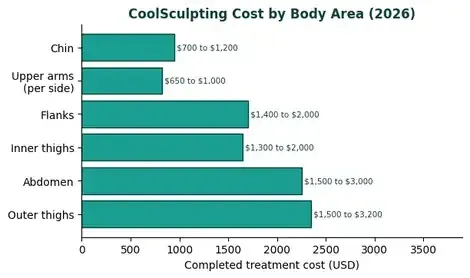 Typical 2026 CoolSculpting cost ranges by body area, reflecting the number of cycles each area usually needs. Source: MedSpaFind market survey of US providers.
CoolSculpting Cost by Body Area
Price tracks the size of the area and the number of applicator cycles it takes to cover it. A chin needs one small applicator, while an abdomen or a pair of outer thighs needs larger applicators and often two rounds spaced weeks apart. The table below sets out realistic 2026 US ranges for a completed treatment of each area, not the single-cycle starting price.
| Body area | Typical cycles | Completed treatment cost | Notes |
|---|---|---|---|
| Chin (submental) | 1 to 2 | $700 to $1,200 | Small applicator, popular starter area |
| Upper arms | 2 total | $650 to $1,000 per side | Priced per arm |
| Flanks (love handles) | 2 to 4 | $1,400 to $2,000 | Treated as a pair |
| Abdomen | 2 to 4 | $1,500 to $3,000 | Larger applicators, often two rounds |
| Outer thighs | 2 to 4 | $1,500 to $3,200 | Priced per pair |
| Inner thighs | 2 | $1,300 to $2,000 | Smaller applicator than outer thighs |
These ranges reflect med spa and clinic pricing on treatments listed across MedSpaFind. Big metros run higher than smaller markets, so a plan in Los Angeles or New York often sits at the top of each range, while Knoxville or Albuquerque may price nearer the bottom. Our CoolSculpting in Miami guide breaks down one market in detail if you want a local example.
Why Most People Need More Than One Cycle
A single cycle reduces the fat in the treated pocket by about 20% to 25%, which is meaningful but rarely the whole job. If you want a flatter abdomen rather than a slightly flatter one, you are usually looking at two or three cycles per area, sometimes spaced six to twelve weeks apart so your body can clear each round. This is the part of the cost that catches people off guard, because the first quote they hear is for one cycle and the plan they actually need is two or three.
Clinics frequently discount when you buy multiple cycles up front, so a package of four cycles often costs less per cycle than buying them one at a time. That said, a good provider will not sell you more cycles than your anatomy needs. If a consultation opens with a large package before anyone has assessed your fat, treat it as a warning sign and get a second opinion from another CoolSculpting clinic.
What Results Can You Actually Expect?
Expect a visible but modest slimming of the treated area, not a dramatic transformation and not weight loss. In practice that means clothes fitting better, a flatter profile in a specific spot, and a contour change that photographs well in before-and-after shots taken from the same angle. The scale usually stays about the same, because you are removing a small volume of fat cells, not pounds of body mass.
How Fat Freezing Works
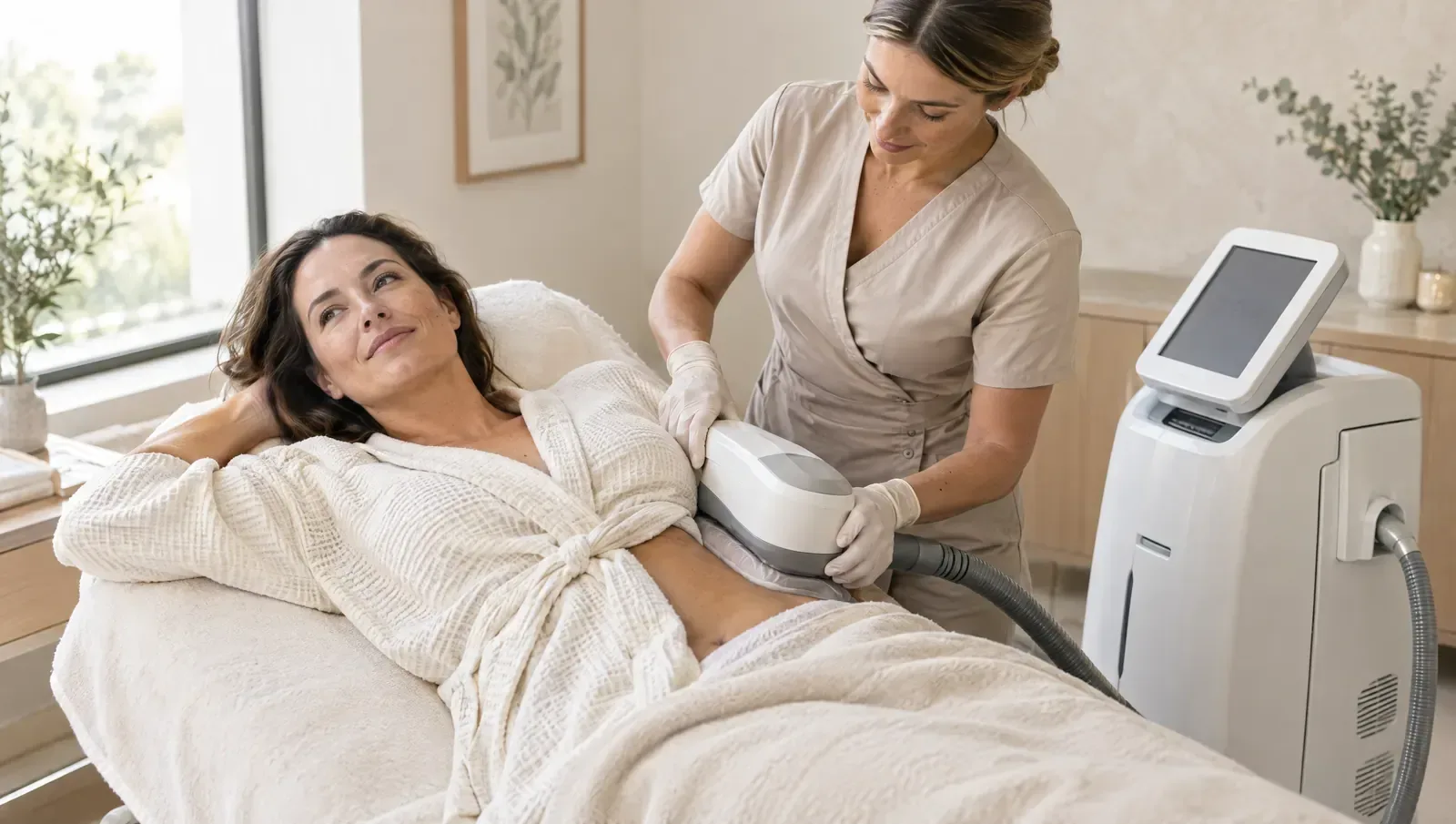
The applicator draws the target tissue between two cooling panels and holds it at a low temperature for roughly 35 to 45 minutes. Fat cells are more vulnerable to cold than the surrounding skin and nerves, so the cold triggers those cells to die off in a process called apoptosis while sparing everything around them. Over the following weeks your lymphatic system flushes the dead cells, and the treated layer gets thinner. Because the cells are physically eliminated, that reduction holds as long as you keep your weight stable.
The Results Timeline
You will not walk out looking different. Early changes show up around three to four weeks, and the fuller result develops over one to three months as your body finishes clearing the treated cells. Most clinics take your comparison photos at the twelve-week mark for that reason. If you treated an area that needs more than one cycle, the timeline resets with each round, so a two-cycle abdomen plan can take four to five months from first session to final result.
| Milestone | What happens | Timeframe |
|---|---|---|
| Treatment day | Cold applicator applied, mild pulling and numbness | 35 to 45 min per cycle |
| First week | Redness, swelling, tenderness, temporary numbness | Days to 2 weeks |
| Weeks 3 to 4 | Early visible slimming begins | About 1 month |
| Weeks 8 to 12 | Fullest result for that cycle | 2 to 3 months |
| Ongoing | Result holds if weight stays stable | Permanent for treated cells |
CoolSculpting Side Effects and Risks
Most CoolSculpting side effects are mild and pass within days to a couple of weeks. The common ones are redness, swelling, bruising, tenderness, tingling, and temporary numbness in the treated area, all of which come from the cold and the suction. Numbness can linger for a few weeks in some people, which is normal and resolves on its own. None of these require downtime, and most patients drive themselves home and go back to work the same day.
Paradoxical Adipose Hyperplasia
The one risk worth understanding before you book is paradoxical adipose hyperplasia, or PAH, where the treated fat enlarges and hardens instead of shrinking. It is uncommon and treatable, but it does not resolve on its own and usually needs liposuction to correct. The manufacturer reports it in roughly 1 in 3,000 to 4,000 cycles, though a 2020 systematic review found the real-world rate may be closer to 1 in 110, which suggests it is underreported. Risk appears higher in men, in people of Hispanic background, when treating the abdomen, and with older applicator models. Asking your provider whether they use current-generation applicators is a fair and useful question.
CoolSculpting is not suitable for everyone. People with cold-related conditions such as cryoglobulinemia, cold agglutinin disease, or paroxysmal cold hemoglobinuria should avoid it, and it is not intended for anyone treating obesity rather than a localized bulge. A proper medical intake before treatment exists to catch exactly these issues, which is one more reason to choose a clinic that assesses you rather than one that simply books you.
CoolSculpting vs the Alternatives
CoolSculpting is one of several ways to reduce fat, and the best choice depends on what you are trying to fix and how much downtime you can accept. Freezing suits targeted, pinchable fat with no recovery time, muscle-stimulating devices suit toning, and surgery suits larger volumes in a single visit. The chart and table below put the realistic 2026 economics and use cases side by side.
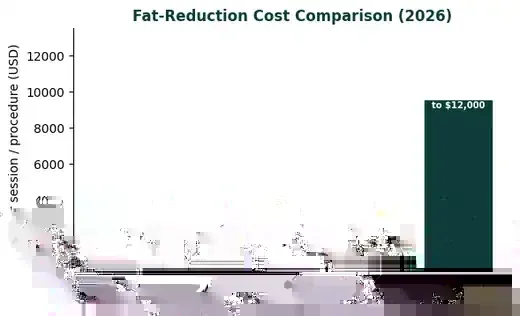 Per-session or per-procedure 2026 cost ranges across common fat-reduction options. Liposuction is a one-time surgical cost; the others are typically repeated. Source: MedSpaFind market survey.
| Treatment | How it works | Typical 2026 cost | Downtime | Best for |
|---|---|---|---|---|
| CoolSculpting | Freezes fat cells (cryolipolysis) | $600 to $1,200 per cycle | None | Targeted, pinchable fat |
| SculpSure | Laser heat destroys fat | $600 to $1,000 per area | None | Flat areas, faster sessions |
| Emsculpt NEO | Electromagnetic muscle plus fat | $750 to $1,000 per session | None | Toning and light fat loss |
| Kybella | Injectable that dissolves fat | $1,200 to $1,800 per plan | Swelling 1 to 2 weeks | Under-chin fat |
| Liposuction | Surgical fat removal | $7,000 to $12,000+ | 1 to 2 weeks | Larger volumes, one visit |
CoolSculpting vs Emsculpt
These two solve different problems. CoolSculpting removes fat, while Emsculpt and Emsculpt NEO mainly build muscle and burn a smaller amount of fat using electromagnetic energy. If your issue is a fat pocket, freezing is the more direct tool. If your issue is a lack of tone or definition on an already lean area, muscle stimulation makes more sense. Some people do both, using CoolSculpting to debulk and Emsculpt to sculpt what remains.
CoolSculpting vs SculpSure
SculpSure reaches a similar goal from the opposite direction, using laser heat instead of cold to disrupt fat cells. Sessions tend to be shorter, around 25 minutes, and it works well on flatter areas that are harder to draw into a cooling applicator. Results and cost land in a comparable range, so the choice often comes down to which device your provider runs and whether your target area suits suction or a flat laser panel. Both fall under the broader non-invasive fat reduction category.
CoolSculpting vs Liposuction
Liposuction is the surgical option, and it removes far more fat in a single visit than CoolSculpting can. If you have a large volume to address or want a dramatic change, lipo does in one procedure what freezing would take many cycles to approximate. The trade-off is real surgery: anesthesia, incisions, one to two weeks of recovery, and a cost that starts around $7,000 for a single area. For a small, stubborn bulge, CoolSculpting is cheaper and easier. For a full contouring of several areas, the cumulative cost of CoolSculpting can approach lipo pricing without matching the result, which is the point where many people choose surgery instead.
CoolSculpting vs GLP-1 Weight Loss
This is the comparison people get wrong most often. GLP-1 medications like semaglutide and tirzepatide reduce overall body fat and body weight, while CoolSculpting only reshapes a specific spot. They are not competitors so much as tools for different jobs. If you have weight to lose, a supervised medical weight-loss program is the starting point, and our guide to semaglutide for weight loss covers how that pathway prices out. Many patients lose the weight first and then use CoolSculpting to address the one or two areas that stay put after the scale has settled.
Who Is CoolSculpting Right For?
The ideal candidate is within about 15 to 30 pounds of their goal weight, has good skin elasticity, and wants to treat a defined bulge that has not budged with diet and exercise. Common targets are the lower abdomen, flanks, inner and outer thighs, upper arms, bra-line fat, and the under-chin area. If you can pinch the fat, it is usually treatable. If the softness is loose skin rather than fat, or if the fat is the deep visceral kind around your organs, CoolSculpting is the wrong tool and a skin-tightening treatment or medical weight loss will serve you better.
It is also worth being honest about expectations. CoolSculpting is a refinement, not a reset. People who go in wanting a subtle, natural improvement to a specific area are the ones who come out satisfied. If you want to look significantly smaller everywhere, no single non-invasive device will get you there, and combining treatments under a provider's plan is the more realistic route. Browsing body contouring options across the directory can help you see the full menu before you commit to one.
How to Choose a CoolSculpting Provider
Choose on candidacy assessment, applicator range, and operator experience rather than the lowest advertised cycle price. The best clinics start with an honest conversation about whether you are even a good candidate, and they will turn away people who would be better served by weight loss or surgery. That willingness to say no is one of the strongest signals you have found a provider worth trusting.
A few practical checks before you book. Ask who performs the treatment and how many cycles they have run, since experienced operators place applicators more accurately and get more even results. Confirm the clinic uses current-generation CoolSculpting or CoolSculpting Elite applicators, which cover more area and carry a lower reported PAH risk than older models. Get the full plan in writing, including the number of cycles and the total cost rather than only the headline per-cycle rate. Read recent reviews for reports of uneven results or complications, and look past the star average to the detail. Compare two or three consultations before committing, and treat a hard upsell on your first visit as a reason to keep looking. You can start by comparing clinics in your metro, whether that is Miami, Dallas, Las Vegas, Scottsdale, or Boston.
Compare CoolSculpting Providers on MedSpaFind
CoolSculpting is worth it when the treatment matches the problem: a targeted, pinchable pocket of fat on someone already close to their goal weight, treated by an experienced provider with a realistic plan. Under those conditions it delivers a permanent, natural-looking reduction with no downtime, which is why three out of four patients say it was worth the money. Outside those conditions, your budget usually goes further on weight loss, muscle toning, or surgery, depending on what you actually want to change.
Ready to look into it? Compare CoolSculpting providers on MedSpaFind, browse med spas across the US, and check pricing on related options like Emsculpt, Kybella, and liposuction so you can weigh the full range before your consultation. If weight loss is the real goal, start with our semaglutide guide, and if skin tightening or resurfacing is part of your plan, our Morpheus8 guide is a useful next read before you book.
CoolSculpting: Frequently Asked Questions
For the right candidate, yes. On RealSelf, 76% of patients say CoolSculpting was worth the roughly $2,425 they paid. It is worth it if you are close to your goal weight and want to reduce a specific, pinchable pocket of fat that resists diet and exercise. It is not worth it if your goal is weight loss or reshaping a large area, where a medical weight-loss program or liposuction gives more for the money.
CoolSculpting costs $600 to $1,200 per applicator cycle in 2026. Smaller areas like the chin or arms run $650 to $1,000 per side, while larger areas like the abdomen need two applicators and cost more per visit. Because most areas need more than one cycle, a completed treatment plan usually totals $2,000 to $4,500.
Yes, the fat cells destroyed in a treated area are gone for good, since the body clears them and does not regrow them. Each cycle reduces the fat in that pocket by about 20% to 25%. The results only last, though, if you keep your weight stable, because the remaining fat cells can still grow if you gain weight.
Most people need 1 to 3 cycles per area to see a clear change, and larger areas like the abdomen or thighs often need two or more rounds spaced six to twelve weeks apart. A single cycle gives a 20% to 25% reduction, which is visible but modest, so a provider will usually recommend a plan based on how much fat you want to remove.
Most side effects are mild and pass within days to two weeks, including redness, swelling, bruising, tenderness, and temporary numbness. The main risk to understand is paradoxical adipose hyperplasia, where treated fat enlarges instead of shrinking. The manufacturer reports it in about 1 in 3,000 to 4,000 cycles, though a 2020 review found the real-world rate may be closer to 1 in 110. It usually needs liposuction to correct.
It depends on how much fat you want to remove. Liposuction removes far more fat in a single surgical visit and gives a more dramatic change, but it costs $7,000 to $12,000 or more and needs one to two weeks of recovery. CoolSculpting is cheaper and has no downtime, but it only reduces a small pocket per cycle. For a small, stubborn bulge, freezing is easier; for a large volume or several areas, surgery often gives a better result for the cost.
No, CoolSculpting is a body-contouring treatment, not a weight-loss treatment. It reshapes a specific area by removing a small volume of fat cells, so the scale barely moves. If your goal is to lose weight, a supervised medical weight-loss program using GLP-1 medication like semaglutide or tirzepatide is the better starting point, and many people use CoolSculpting afterward to address the one or two spots that stay put.