

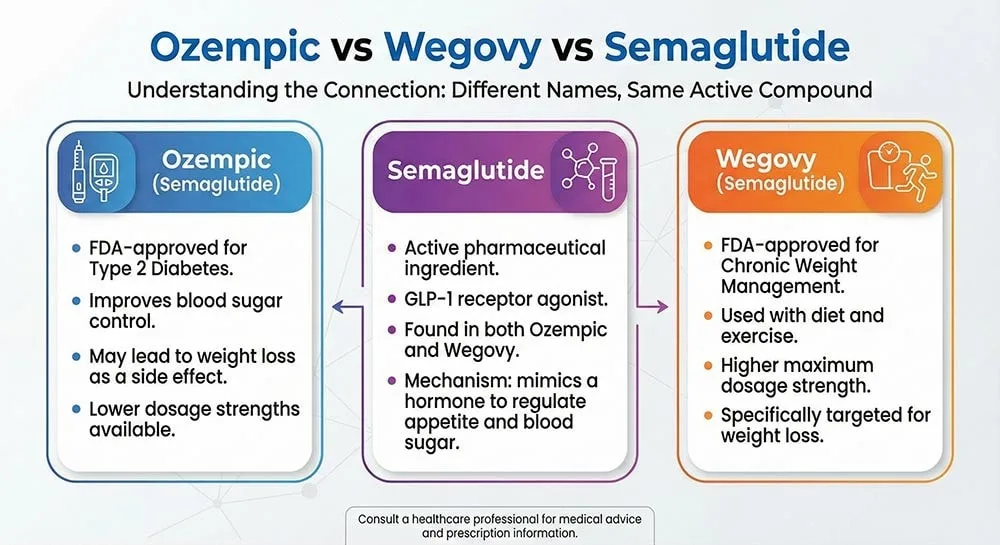
Ozempic and semaglutide are closely related — because semaglutide is the active ingredient in the brand-name drug Ozempic. The part that trips people up is that the same medication shows up under different brand names, different doses, and different FDA approvals depending on the goal.
- •Ozempic is FDA-approved for type 2 diabetes, and weight loss can happen as a side effect.
- •Wegovy is also semaglutide, but FDA-approved specifically for chronic weight management at a higher maintenance dose (2.4 mg weekly).
- •As of December 2025, the FDA also approved a daily oral Wegovy tablet — a significant development for people who prefer not to inject.
So when someone says "I'm on semaglutide," they might mean Ozempic, Wegovy, or a compounded product. That's where confusion — and sometimes risk — creeps in.
Semaglutide vs. Ozempic vs. Wegovy: Key Differences
| Feature | Semaglutide (Generic Name) | Ozempic | Wegovy |
|---|---|---|---|
| Active Ingredient | Semaglutide | Semaglutide | Semaglutide |
| Primary FDA Approval | No approved generic. "Semaglutide" often refers to compounded versions. | Type 2 diabetes management | Chronic weight management |
| Typical Dosage | Varies widely; compounded dosing differs by clinic | Up to 2 mg once weekly | 2.4 mg once weekly (maintenance) |
| FDA-Approved for Weight Loss? | No approved generic version | No (weight loss is a side effect) | Yes |
| Insurance Coverage | Varies; often out of pocket | Often covered for diabetes | Varies; many plans restrict weight loss coverage |
How They Work for Weight Loss
Semaglutide is a GLP-1 receptor agonist — it mimics a hormone your body already uses after eating. The main effects people notice are:
- 1Slower gastric emptying: Food stays in the stomach longer, which can make you feel full sooner and for longer.
- 2Reduced appetite and "food noise": Many patients describe finally being able to stop thinking about food constantly. Not everyone feels it, but it's common.
- 3Improved blood sugar control: It supports insulin release in a glucose-dependent way — which is why Ozempic is positioned as a diabetes medication.
Real-World Weight Loss Expectations
In the STEP 1 trial (semaglutide 2.4 mg weekly), average weight change at 68 weeks was about 14.9% with semaglutide vs. 2.4% with placebo. That's meaningful, but results vary widely. Some people lose 5%, some 20% or more. Lifestyle, dose tolerance, sleep, alcohol intake, stress, and genetics all matter.
Dosing Schedules: Where the Confusion Starts
Same medication, different intent, different dose ceilings, and different end goals. Ozempic dosing is designed primarily around blood sugar control. Wegovy is intentionally pushed to a higher maintenance dose to maximize appetite suppression and sustained fat loss.
| Week | Ozempic (Diabetes-Focused) | Wegovy (Weight Loss-Focused) |
|---|---|---|
| Weeks 1–4 | 0.25 mg (starter dose) | 0.25 mg |
| Weeks 5–8 | 0.5 mg | 0.5 mg |
| Weeks 9–12 | 1.0 mg | 1.0 mg |
| Weeks 13–16 | 1.0–2.0 mg (optional increase) | 1.7 mg |
| Maintenance | Up to 2.0 mg weekly | 2.4 mg weekly |
With Ozempic, many people never move beyond 1 or 2 mg. With Wegovy, the expectation is progression unless side effects force a pause. Some clinicians keep patients at lower-than-maximum doses if appetite control feels adequate — neither approach is automatically wrong, but expectations should be set early.
How Long Does Semaglutide Take to Work?
Most people notice appetite changes within 2 to 4 weeks. Actual scale movement often lags, sometimes by a month or more. Here's a realistic timeline:
- •Weeks 1–4: Appetite slightly quieter, mild nausea possible, weight change minimal.
- •Weeks 5–12: Reduced portions feel natural, steady weight loss begins.
- •Months 4–8: Most visible body changes happen here.
- •After 1 year: Weight loss plateaus for many; maintenance becomes the new challenge.
People who expect instant results often quit early. People who expect slow, uneven progress tend to do better.
Who Is a Good Candidate?
Common Criteria for Wegovy Eligibility
- •BMI ≥30, or
- •BMI ≥27 with at least one weight-related condition (hypertension, dyslipidemia, sleep apnea, insulin resistance).
Ozempic Is Typically Prescribed For
- •Type 2 diabetes.
- •Insulin resistance with poor glycemic control.
- •Sometimes off-label for weight loss when Wegovy is unavailable.
Who Should Not Use Semaglutide Without Careful Evaluation
- •History of medullary thyroid carcinoma.
- •Multiple endocrine neoplasia syndrome type 2 (MEN2).
- •Prior severe pancreatitis.
- •Pregnancy or breastfeeding.
Side Effects: What's Normal, What's Not
- •Nausea
- •Constipation or diarrhea
- •Early fullness
- •Acid reflux
- •Fatigue during dose increases
- •Persistent vomiting
- •Severe abdominal pain
- •Signs of gallbladder issues
- •Dehydration
People who eat slowly, prioritize protein, and hydrate aggressively tend to tolerate semaglutide better. People who push through nausea with greasy foods usually regret it.
Compounded Semaglutide: Why This Keeps Coming Up
When people say "generic semaglutide," they usually mean compounded semaglutide. This exists because of supply shortages and cost barriers. However, compounded products are not FDA-approved in the same way brand-name medications are. The FDA has issued warnings about unapproved compounded GLP-1 drugs, including concerns about dosing errors, potentially fraudulent products, and misleading labeling.
That doesn't automatically make compounded products unsafe — but potency can vary, dosing errors are more likely, and source quality matters enormously. If compounded options are discussed, it should be with full transparency and proper medical supervision. Vague or rushed conversations about this are a red flag.
Cost and Insurance: The Part Everyone Hates
- •Ozempic (insured for diabetes): Often $25–$75 copay.
- •Wegovy (without coverage): $1,200–$1,500 per month.
- •Compounded semaglutide: $250–$600 per month.
Insurance coverage for weight loss medications remains inconsistent. Some employers cover Wegovy. Many explicitly exclude weight loss drugs. Prior authorizations and denials are both common. Clinics that help navigate insurance paperwork are doing more than it might seem.
What Happens When You Stop Semaglutide?
Most people experience some degree of weight regain after stopping. Appetite returns. Hunger cues feel louder. Old habits, if only suppressed rather than rebuilt, tend to creep back. That doesn't mean the medication "failed" — it means it was doing part of the work. The three most common outcomes are:
- 1Weight regain without a maintenance plan: The most common scenario. Medication stops, appetite returns quickly, weight follows.
- 2Partial regain with lifestyle support: People who used the medication as a window to build habits — smaller portions, slower eating, higher protein — tend to regain less.
- 3Long-term low-dose or cycling strategy: Some patients remain on a lower maintenance dose long term. Others pause and restart under supervision. This is not failure — it's chronic disease management thinking.
Maintenance Strategies That Actually Work
- •Prioritizing protein intake, even when appetite is low.
- •Resistance training, even twice per week.
- •Structured follow-ups with a clinician.
- •Gradual dose changes instead of abrupt stops.
- •"I'll just eat intuitively again."
- •Extreme calorie restriction after stopping.
- •Expecting hunger cues to stay muted indefinitely.
Ozempic vs. Wegovy: Which Is Better for Weight Loss?
- •You have type 2 diabetes.
- •Insurance covers it but excludes Wegovy.
- •You respond well at lower doses.
- •You want more flexibility in dosing.
- •Weight loss is the primary goal.
- •You tolerate higher doses.
- •Insurance coverage is available.
- •You want FDA approval specifically for weight management.
Common Myths Worth Clearing Up
- •"Ozempic melts fat without effort." No. It reduces appetite. Behavior still matters.
- •"If I feel nauseous, it's working better." Not necessarily. Severe nausea often means the dose increased too fast.
- •"Once I hit my goal weight, I can stop without consequences." Sometimes. Often not. Planning ahead matters significantly.
- •"Compounded semaglutide is exactly the same." It can be similar, but it is not regulated the same way.
Choosing the Right Clinic Matters More Than Choosing the Drug
Two patients can take the same drug and have wildly different experiences based on how fast the dose is increased, whether side effects are managed proactively, if labs are monitored, if nutrition guidance is included, and whether maintenance is discussed before starting. Clinics that treat weight loss as a process rather than a transaction tend to produce better outcomes.
Semaglutide does not magically change who you are around food. What it does — subtly but powerfully — is create mental quiet. The constant pull toward eating eases. Portions shrink without feeling forced. That space is where real change can happen, if someone uses it well.
FAQ Ozempic vs Semaglutide
Semaglutide is the active ingredient. Ozempic is a brand-name medication that contains semaglutide and is FDA-approved for type 2 diabetes.
Wegovy is approved specifically for weight loss and is typically used at higher doses, which may lead to greater weight loss for some people.
Many people lose 15–20% of their body weight over about one year, though individual results vary.
Weight regain is common without a maintenance plan, especially if lifestyle changes are not sustained.