Laser hair removal in Miami costs $55 to $180 per session for small areas like the upper lip or underarms, $130 to $380 for medium and large areas such as the bikini line or lower legs, and $450 to $900 for full body. Most people need 6 to 8 sessions, and package pricing brings the per-visit rate down by roughly 15 to 25 percent.
Miami is one of the busiest laser hair removal markets in the country, and that works in your favor. Between the year-round beach season, a dense cluster of med spas across Brickell, Coral Gables, and South Beach, and a patient population that spans every Fitzpatrick skin type, clinics here compete hard on both price and technology. The tradeoff is that quality varies more than in smaller markets, and the cheapest package on Groupon is often run on an older device by a technician who has never treated skin like yours.
This guide covers what you should actually pay in 2026, how prices shift by neighborhood, which laser wavelength matters for your skin tone, and how to tell a well-run clinic from a discount mill. When you are ready to compare providers, you can browse med spas in Miami on MedSpaFind or go straight to the laser hair removal service page to filter by treatment.
Laser hair removal cost in Miami: the 2026 numbers
| Treatment area | Per session (Miami 2026) | 6-session package | Sessions most people need |
|---|---|---|---|
| Upper lip | $55 to $110 | $280 to $550 | 6 to 8 |
| Chin | $60 to $120 | $300 to $600 | 6 to 10 |
| Underarms | $75 to $150 | $380 to $720 | 6 to 8 |
| Bikini line | $90 to $180 | $450 to $880 | 6 to 8 |
| Brazilian | $150 to $300 | $800 to $1,650 | 6 to 9 |
| Lower arms | $130 to $240 | $650 to $1,150 | 6 to 8 |
| Chest | $175 to $340 | $900 to $1,650 | 6 to 10 |
| Lower legs | $200 to $380 | $1,000 to $1,850 | 6 to 8 |
| Back | $250 to $480 | $1,300 to $2,300 | 8 to 10 |
| Full legs | $300 to $600 | $1,550 to $2,900 | 6 to 8 |
| Full body | $450 to $900 | $2,400 to $4,500 | 6 to 8 |
A few things stand out when you compare this to the rest of the country. Miami sits close to the national midpoint, cheaper than Manhattan and Beverly Hills but a little above Phoenix or Houston. Our Los Angeles laser hair removal guide shows LA running about 10 to 20 percent higher on large areas, while Las Vegas pricing lands slightly under Miami on packages. For the national picture, our US cost breakdown covers the broader range.
What you actually pay: packages versus single sessions
Almost nobody buys laser hair removal one session at a time, and clinics price accordingly. The standard structure in Miami is a package of 6, sometimes 8, sessions purchased upfront at a 15 to 25 percent discount off the single-visit rate. A handful of larger chains sell unlimited-area memberships for a monthly fee, which can work out if you are treating several zones at once and are disciplined about showing up.
Package math for a Brazilian. At a mid-market Coral Gables clinic charging $220 per session, six sessions bought individually would run $1,320. The same six sold as a package typically lands between $1,050 and $1,150. If you later need two touch-up sessions, most clinics offer them at 40 to 50 percent off the single-session rate once you have completed a series, so budget another $220 to $260.
Watch the fine print on expiry. Packages in Miami commonly expire 12 to 18 months after purchase. Since sessions are spaced 4 to 6 weeks apart on the body and 6 to 8 weeks on the face, six sessions take about 8 to 12 months in practice. That is workable, but a summer travel schedule or a pregnancy can eat the window fast. Ask whether unused sessions carry over or transfer.
Groupon and intro offers. Deep-discount intro deals are everywhere in Miami and they are not automatically a trap. They are a reasonable way to test a clinic's technique and comfort level on a small area before committing to a full package. What you should not do is buy a full-body Groupon package from a clinic you have never visited, because the redemption experience at high-volume deal shops is frequently rushed and the device is often set conservatively low to avoid complaints.
How Miami neighborhoods price differently
Location moves the number more than most people expect. The same 6-session Brazilian package can differ by $800 between Kendall and Bal Harbour, and the underlying treatment is often comparable.
Brickell and Downtown. The highest concentration of med spas per square mile in the county, and pricing to match at roughly 10 to 20 percent above the metro average. What you get for it is newer equipment, longer hours that accommodate a work schedule, and clinics that tend to carry more than one laser platform. Brickell providers also cross-sell heavily, so expect to be offered Botox or a HydraFacial at consultation.
Coral Gables and Pinecrest. Slightly quieter, often physician-owned, and popular with patients who want a dermatologist or plastic surgeon on site. Prices sit near or just above the metro average. Browse Coral Gables med spas if that setup matters to you, and look at Pinecrest listings alongside them.
South Beach and Miami Beach. Tourist-facing pricing on walk-ins, but competitive package rates if you live locally and ask. Some clinics run genuinely good resident discounts that are never advertised. See what is available across Miami Beach, and check North Miami Beach too, since the rates there drop noticeably.
Aventura and Bay Harbour Islands. The northern corridor skews premium, with Bal Harbour and Bay Harbor Islands at the top of the range. Aventura offers better value than its neighbors while still drawing from the same experienced technician pool.
Doral, Hialeah, and Kendall. The best straight value in the metro. Packages run 20 to 30 percent below Brickell for comparable devices, and many clinics here have deep experience with Fitzpatrick IV through VI skin because of the patient base they serve. Doral clinics and South Miami providers are worth a consultation if budget is a real constraint.
Why your skin tone changes the equation in Miami
| Fitzpatrick type | Typical laser | Wavelength | Notes |
|---|---|---|---|
| I to II (very fair) | Alexandrite | 755 nm | Fast, effective on fine light-brown hair |
| III to IV (olive, light brown) | Diode | 800 to 810 nm | The Miami workhorse, good balance of speed and safety |
| IV to VI (brown to deep brown) | Nd:YAG | 1064 nm | Penetrates deeper, bypasses epidermal melanin, safest for deeper tones |
| Any type, tanned skin | Nd:YAG | 1064 nm | Recent sun exposure raises risk on shorter wavelengths |
The practical rule for Miami: if your skin is Fitzpatrick IV or above, or if you have any tan at all, ask specifically whether the clinic has a 1064 nm Nd:YAG and whether the person treating you has run it on skin like yours. A clinic with only an Alexandrite platform is not equipped to treat you safely, and a technician who does not know the answer is telling you something useful. Our guide to Fitzpatrick skin types walks through how to identify where you land.
Nd:YAG treatment does have a cost implication. It generally requires one to three more sessions than Alexandrite or diode to reach the same reduction, and some clinics charge a modest premium for it. Factor an extra $150 to $400 into a full course.
The other Miami-specific issue is sun. You cannot be freshly tanned when you are treated, and you need to stay out of direct sun and off self-tanner for about two weeks before and after each session. In practice that means scheduling around your beach habits, not the other way around, and being honest with your provider about a recent trip. Plenty of people run their course between October and April for exactly this reason, then maintain through the summer.
What affects your final price
Hair color and coarseness. Dark, coarse hair responds best because it holds the most melanin. Fine blonde, red, gray, and white hair have very little pigment to target, and laser will do close to nothing on them regardless of what you pay. Electrolysis is the honest answer for those cases.
Hormonal factors. PCOS, thyroid conditions, perimenopause, and hormone therapy all drive continued hair growth, particularly on the face, chin, and neck. Patients with hormonal drivers routinely need 10 to 12 sessions plus ongoing maintenance every 6 to 12 months. A good clinic will tell you this at consultation rather than sell you a six-pack and act surprised later.
Who is holding the device. Florida allows laser hair removal to be performed by an appropriately trained and supervised practitioner under a physician's authority. In practice you will encounter licensed medical estheticians, registered nurses, nurse practitioners, physician assistants, and physicians. Credentials matter less than device-specific hours: someone who has run the same platform 2,000 times will get you a better result than a recent hire with an impressive title. Ask how long they have used that particular machine.
Device quality. Names worth recognizing on a Miami consultation are Candela GentleMax Pro, Cynosure Elite iQ, Lumenis Splendor X, and Alma Soprano ICE or Soprano Titanium. Devices that combine wavelengths in a single platform let a technician tailor treatment to your skin rather than force one setting on everyone. If a clinic will not name their device, that is a real signal.
Numbing and add-ons. Topical anesthetic is usually $25 to $50 if you want it, and it is worth considering for Brazilians and the upper lip. Most other areas are tolerable on modern devices with contact cooling.
Laser hair removal compared to the alternatives
| Method | Miami cost | Result | Best for |
|---|---|---|---|
| Laser hair removal | $1,000 to $2,000 per area, full course | 80 to 95 percent permanent reduction | Dark hair, medium to large areas |
| Electrolysis | $60 to $120 per hour, many hours | True permanent removal | Blonde, gray, red, or white hair |
| IPL at a clinic | $70 to $180 per session | Modest reduction, more sessions | Fair skin with dark hair only |
| At-home IPL device | $200 to $500 one time | Temporary thinning, needs upkeep | Maintenance between clinic visits |
| Waxing | $40 to $90 per visit, every 4 weeks | Temporary | Short-term, occasional need |
Run the lifetime math and laser usually wins for anyone waxing regularly. Waxing a Brazilian every four weeks at $65 comes to roughly $845 a year, indefinitely. A laser course at $1,100 is paid off inside 16 months and then costs you a maintenance session or two annually. That calculation is a large part of why the treatment stays popular in Miami even when discretionary spending tightens.
Clinic-grade IPL is a different technology from laser and gets confused with it constantly. IPL uses broad-spectrum light rather than a single wavelength, which makes it less precise and considerably riskier on deeper skin tones. It has real uses for pigmentation and redness, but as a hair removal tool in Miami it is the wrong pick for most of the population. If you are curious about consumer devices, we covered at-home laser hair removal safety separately.
What a session in Miami actually looks like
You will shave the area 12 to 24 hours before, not wax or pluck, because the laser needs the follicle intact below the surface but the hair above the skin gone. Show up with clean bare skin. Lotion and makeup have to come off, and if you are treating underarms, skip the deodorant that morning.
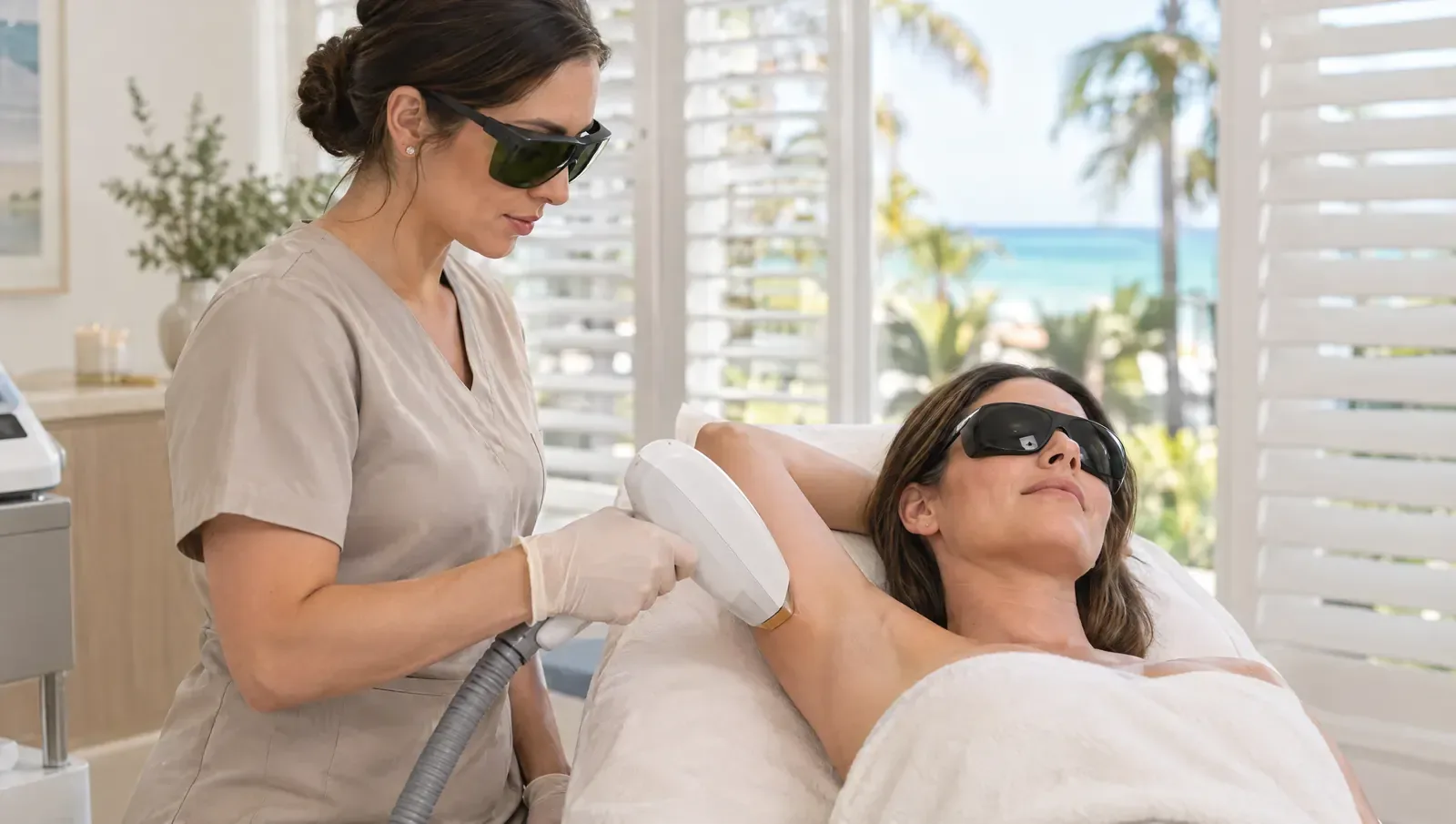
Everyone in the room wears protective eyewear. The technician does a test pulse on a small patch, waits a minute, checks the response, then adjusts energy up or down. A rushed provider who skips the test patch on a new patient is cutting a corner that occasionally causes real injury. The sensation is commonly described as a rubber band snap with a warm sting behind it, and modern devices with contact cooling or cryogen spray take most of the edge off.
Underarms take about 5 minutes. A Brazilian runs 15 to 20. Full legs are 45 to 60. Afterward the treated skin is pink and slightly swollen around each follicle, similar to mild razor burn, and that settles within a few hours to a day. Aloe and a cool compress help. Skip the gym, hot showers, saunas, and the beach for 48 hours, and use SPF 30 or higher on any exposed area for the following two weeks. In August in Miami that is not optional advice.
Shedding starts around day 7 to 14 and looks like regrowth at first. It is not. The hairs are being pushed out. Do not pluck, and do not panic when a patch appears to come back before your next appointment.
How to choose a Miami clinic without getting burned
Insist on a real consultation and a test patch. Any clinic that will book you for a full-area first treatment sight unseen is skipping the step that protects you. This matters most for Fitzpatrick IV and above.
Ask what device, and how many wavelengths. A single-platform clinic can only treat one kind of patient well. Ask which one you are.
Ask who supervises. There should be a physician medical director with an actual relationship to the practice, and the treating provider should be able to name them.
Read the reviews for complications, not for vibes. Filter for mentions of burns, blistering, and hyperpigmentation. One bad outcome in hundreds of reviews is noise. A pattern is not.
Get the total in writing. Number of sessions, price per session, package total, what a touch-up costs after the series, and the expiry date. Clinics that quote a monthly membership figure without an annual total are counting on you not doing the arithmetic.
Match the clinic to the area you are treating. A high-volume laser-only chain is genuinely good at legs and underarms at a competitive price. A physician-led practice is a better fit for facial hair with a hormonal component, or for deeper skin tones where an experienced hand with Nd:YAG is worth paying for.
Building a treatment plan around Miami's calendar
Sun exposure is the main scheduling constraint here, and the smart move is to start a course in the fall. Beginning in October puts your sixth session around March, which lands you finished before peak beach season with time for a touch-up if you need one. Starting in June means either interrupting the course or skipping the water for months, and interrupted courses produce worse results because the spacing is timed to the hair growth cycle.
Face and neck sessions space 6 to 8 weeks apart. Body areas run 4 to 6 weeks. Coarse areas like the back and chest often stretch to 8 weeks. If a clinic wants to schedule you every two weeks, they are selling sessions rather than results, because hair in the resting phase simply is not susceptible to treatment.
Plan on maintenance. FDA language for this treatment is permanent hair reduction, not permanent removal, and that distinction is real. Most people see 80 to 95 percent fewer hairs after a full course and then need a single touch-up every 12 to 24 months. Budget $80 to $200 a year for that depending on the area.
Pairing laser with other treatments
Miami patients frequently run laser hair removal alongside other services, and sequencing matters. Do not schedule a chemical peel or dermaplaning on the same skin within two weeks of a laser session, since both compromise the barrier you need intact. HydraFacial is gentler and can usually be booked a week out.
Injectables are unrelated to skin barrier concerns, so dermal fillers and neuromodulators can be scheduled independently, though most providers prefer to avoid treating the exact same facial zone on the same day. Body treatments like CoolSculpting and skin tightening with Morpheus8 have no conflict with laser hair removal on different areas. If you are mapping out a broader plan, our guide to the best med spas in Miami covers which clinics do several of these well under one roof, and the Miami Botox price guide and HydraFacial cost guide handle budgeting for the rest.
Compare Miami laser hair removal providers
Pricing in this market is wide enough that a single consultation tells you very little. Get quotes from three clinics in different neighborhoods, confirm the device and the wavelength each one would use on your skin, and compare the package total rather than the headline per-session rate.
MedSpaFind lists laser hair removal providers across the metro so you can compare them in one place rather than calling around. Start with med spas in Miami, filter down to the laser hair removal directory, and check the wider body treatment category if you are planning more than one service. The Florida directory covers every listed provider statewide if you are open to driving.
Frequently asked questions about laser hair removal in Miami
Single sessions in Miami run $55 to $110 for the upper lip, $75 to $150 for underarms, $150 to $300 for a Brazilian, $300 to $600 for full legs, and $450 to $900 for full body. Most clinics sell 6-session packages at a 15 to 25 percent discount, which is how nearly everyone actually buys it.
Most people need 6 to 8 sessions for 80 to 95 percent permanent hair reduction. Coarse areas like the back and chest often take 8 to 10. If you have PCOS, a thyroid condition, or another hormonal driver, expect 10 to 12 sessions plus maintenance every 6 to 12 months.
Yes, when the clinic uses a 1064 nm Nd:YAG laser. That wavelength penetrates deeper and largely bypasses melanin in the epidermis, which is what makes it appropriate for Fitzpatrick IV through VI skin. Ask directly whether the clinic has an Nd:YAG and how much experience the technician has running it on skin like yours. An Alexandrite-only clinic is not equipped to treat deeper tones safely.
Kendall, Hialeah, and Doral consistently price 20 to 30 percent below Brickell and the beachfront neighborhoods for comparable devices. A 6-session Brazilian package runs roughly $990 to $1,120 there versus $1,650 in Brickell and $1,880 in Bal Harbour.
October is the ideal start. Sessions are spaced 4 to 6 weeks apart on the body, so beginning in the fall puts your sixth session around March, before peak beach season. You need to avoid sun and self-tanner for about two weeks before and after each session, which is difficult to manage through a Miami summer.
Most people describe it as a rubber band snap with a warm sting behind it. Modern devices with contact cooling or cryogen spray take most of the edge off. Underarms and legs are generally easy. Brazilians and the upper lip are the areas where topical numbing, usually $25 to $50, is worth considering.
The FDA approves it for permanent hair reduction rather than permanent removal, and the distinction matters. After a full course you should see 80 to 95 percent fewer hairs in the treated area, and that result holds for years. Most people need one touch-up session every 12 to 24 months, which runs $80 to $200 depending on the area.
No. Laser targets melanin in the follicle, and blonde, red, gray, and white hair have too little pigment for the energy to find. Electrolysis is the only method that reliably removes light-colored hair permanently, though it is slower and priced by the hour.