
Jul 13, 2026
Morpheus8 vs Microneedling: Which Is Worth It in 2026?
Morpheus8 vs microneedling in 2026: how they differ, real cost by city ($200-$700 vs $700-$1,500), downtime, sessions, and which one is worth it for your skin.
 RF microneedling devices like Morpheus8 pair fine needles with radiofrequency heat, while traditional microneedling relies on needles alone.
Morpheus8 adds radiofrequency heat to microneedling, so it reaches deeper and tightens loose skin that plain microneedling cannot touch. Expect to pay $700 to $1,500 per Morpheus8 session versus $200 to $700 for traditional microneedling in 2026. Microneedling wins on price and glow. Morpheus8 wins on sagging, jowls, and deeper scars.
The short version
Both treatments start the same way, with tiny needles that create controlled micro-injuries and prompt your skin to build new collagen. The difference is what happens after the needles go in. Morpheus8 sends radiofrequency energy through those needles and heats the deeper layers of the dermis, which is how it firms and lifts. Traditional microneedling stops at the mechanical injury and works closer to the surface.
That single design choice explains almost every practical difference in price, downtime, number of sessions, and the kind of results you can expect. If your main concern is texture, large pores, fine lines, or a dull complexion, microneedling usually does the job for a fraction of the cost. If you are watching early jowling, crepey skin under the eyes, or a softening jawline, the deeper heat of Morpheus8 is worth the higher price. Below is the data, the pricing by city, and a clear way to decide.
How the two treatments actually differ
Microneedling has been a clinic staple for over a decade. A pen or roller studded with fine needles punctures the top layers of skin to a depth of roughly 0.5 mm to 2.5 mm. Your body reads those punctures as injuries and responds by producing collagen and elastin, which is what smooths texture and softens fine lines over a series of visits. Many clinics pair it with PRP, or platelet-rich plasma, the so-called vampire facial, to speed healing and boost the collagen response.
Morpheus8 is a branded radiofrequency microneedling device from InMode. The needles still create channels in the skin, but they also deliver RF energy at the tip, heating tissue as deep as 4 mm. That heat contracts existing collagen right away and triggers a stronger remodeling response over the following months. Because it reaches the subdermal layer where fat and structural tissue sit, it can subtly tighten and recontour in a way surface microneedling simply cannot.
Think of it this way. Standard microneedling renovates the surface of a room. Morpheus8 works on the framing behind the wall. Both have their place, and neither is a facelift.
Side-by-side comparison
| Factor | Traditional microneedling | Morpheus8 (RF microneedling) |
|---|---|---|
| Technology | Fine needles only | Needles plus radiofrequency heat |
| Treatment depth | 0.5 mm to 2.5 mm | Up to 4 mm, adjustable |
| Best for | Texture, fine lines, pores, dull skin, mild acne scars | Skin laxity, jowls, crepey skin, deeper scars, jawline |
| Price per session (2026) | $200 to $700 | $700 to $1,500 (higher in major metros) |
| Sessions for a full result | 4 to 6 | 2 to 3 |
| Downtime | Redness 24 to 48 hours | Redness and swelling 1 to 5 days, pinpoint marks possible |
| Results last | About 1 year with maintenance | 12 to 18 months, sometimes longer |
| Comfort | Numbing cream usually enough | Numbing cream, more heat sensation |
| Skin tone safety | Safe across tones | RF energy is generally safe for darker tones when set correctly |
What each one costs in 2026
Pricing is where most people make the decision, so here is the current picture. Traditional microneedling runs about $200 to $700 per session nationally, and closer to $500 to $900 when PRP is added because the provider has to draw and spin your blood. Morpheus8 sits well above that, generally $700 to $1,500 for a full face, with body areas and premium metro clinics pushing past $2,000 per session.
Location matters more than most patients expect. A Morpheus8 session in New York or Los Angeles can cost roughly double what the same treatment runs in a smaller market. The chart below shows how per-session pricing shifts across major US cities based on ranges compiled from provider listings in the MedSpaFind directory.
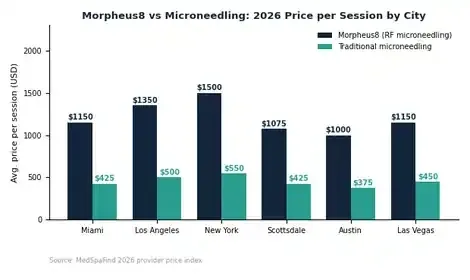 Average 2026 per-session pricing by city. Morpheus8 consistently runs three to four times the cost of traditional microneedling. Source: MedSpaFind provider price index.
The gap looks dramatic, but the honest comparison is a full course, not a single visit. Microneedling usually needs 4 to 6 sessions to reach its result, while Morpheus8 gets there in 2 to 3. Once you multiply out the sessions, the total spend lands closer together than the sticker price suggests. Add PRP to microneedling and the two can nearly meet in the middle.
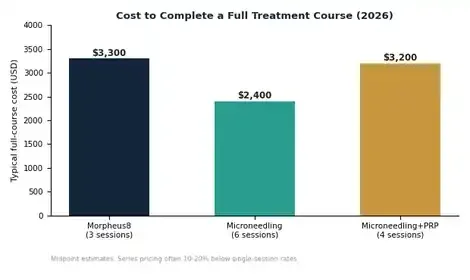 Typical full-course cost for each treatment in 2026, using midpoint pricing. Package deals often trim 10 to 20 percent off single-session rates.
Why Morpheus8 costs more
The price difference is not clinic markup for its own sake. Morpheus8 is a physician-grade device with a real equipment cost, single-use sterile tips that get thrown away after every patient, and manufacturer training that clinics pay for. The RF component also puts the treatment in a higher risk category, which usually means a more experienced provider is running it. You are paying for the technology and the skill to use it safely. Traditional microneedling pens are far cheaper to own and operate, which is a big part of why a session can dip under $250 when clinics run promotions. If a Morpheus8 quote looks suspiciously low, ask what device they actually use, since some clinics market generic RF microneedling under the Morpheus8 name.
Regional price notes
In Miami and across South Florida, competition keeps microneedling promotions common, often around $250 to $350 a session, while Morpheus8 tends to start near $900. Brickell and Coral Gables clinics generally price at the top of that range, while providers a little further from the water tend to be gentler on the wallet. Scottsdale and Austin sit close to the national average. Las Vegas pricing swings widely, with strip-adjacent clinics charging a premium. In Los Angeles, expect Beverly Hills and West Hollywood addresses to carry a noticeable surcharge over the same treatment in outer neighborhoods. In Canada, microneedling runs about CA$250 to CA$500 in Toronto and Vancouver, with Morpheus8 commonly CA$900 to CA$1,800 per session, and Yorkville clinics in Toronto sitting at the higher end. Always ask whether a quoted Morpheus8 price is per session or for a package, since that one detail changes the math completely.
Downtime, pain, and recovery
Neither treatment is a lunchtime procedure if you want visible results, but the recovery curves differ. After traditional microneedling most people look flushed for 24 to 48 hours, similar to a mild sunburn, then return to normal quickly. Makeup usually goes back on within a day or two.
Morpheus8 asks for a bit more. Redness and mild swelling are common for one to five days, and because the needles go deeper you may see faint pinpoint marks or a sandpaper texture that lingers for several days. A full-face treatment can occasionally keep you looking pink for up to two weeks if your provider runs it aggressively. Most patients are back to daily life within 48 hours and simply plan the treatment away from any big event.
Comfort is manageable for both. A topical numbing cream sits on the skin for 30 to 45 minutes beforehand. Microneedling feels like light scratching. Morpheus8 adds a warm, prickly sensation from the RF energy, which some people find more intense, especially along the jaw and forehead where skin is thin over bone.
Results and timeline: what to actually expect
Collagen takes time, so patience matters with either treatment. With microneedling, texture and glow improve over the series, and most people see their best result a few weeks after the final session. It is a reliable choice for enlarged pores, dullness, superficial acne scarring, and early fine lines.
Morpheus8 builds more slowly and more dramatically. Early softening shows up within a few weeks, but the tightening and lifting keep developing for three to six months as new collagen matures. That is why it is the stronger pick for skin laxity, a blurring jawline, crepey texture under the eyes, and deeper scars. Results tend to hold for 12 to 18 months, and many patients return once a year for a single maintenance session.
One realistic caveat. Neither device replaces surgery. If you have significant sagging, a provider who is honest will tell you that Morpheus8 can improve but not erase it, and may point you toward a consultation with a board-certified dermatologist or plastic surgeon instead. Good clinics set expectations before they take your deposit.
Are you a good candidate?
Most healthy adults can have either treatment, but a few things rule you out or call for a pause. Active acne breakouts, an open cold sore, a current skin infection, or a recent sunburn all mean you reschedule. If you are pregnant or breastfeeding, most clinics will ask you to wait. People prone to keloid scarring should raise it at the consultation, and anyone on isotretinoin usually needs to be off it for several months first.
Skin tone is the question patients with deeper complexions ask most, and it is a fair one. Older resurfacing lasers carried a real risk of pigment changes on melanin-rich skin. RF microneedling is different, because the radiofrequency energy targets water in the tissue rather than pigment, so Morpheus8 is generally considered safe across the Fitzpatrick scale when the settings are right. That last part is the catch. A provider who knows how to dial in depth and energy for your skin is the difference between a good outcome and a bad one, which is why experience matters more than the brand name on the machine.
It helps to think in terms of yearly cost, not one appointment. A microneedling patient who does a spring series and a couple of touch-ups might spend a few hundred dollars a year to hold a result. A Morpheus8 patient often front-loads two or three sessions, then keeps it up with a single annual visit, so the ongoing cost settles down after the first year. Neither is cheap, but framed as a yearly skincare line item rather than a one-time purchase, the gap between them feels smaller and the decision gets easier.
Can you combine them, or do other treatments first?
You do not have to pick one treatment and marry it. Many patients rotate. Someone might run a series of microneedling in their 30s for texture, then graduate to Morpheus8 a few years later as firmness starts to slip. Others use Morpheus8 once or twice a year for structure and keep a lighter treatment like a HydraFacial or chemical peel in the calendar for glow between visits.
What you should not do is stack aggressive treatments on top of each other in the same window. Doing a peel, a laser, and RF microneedling within days is asking for trouble. Space them out, let the skin recover, and let a provider sequence them. If budget is the constraint, a common and sensible plan is to start with microneedling plus PRP, see how far that gets you, and only step up to RF microneedling if the results plateau.
Common mistakes people make
The biggest one is chasing the wrong tool for the problem. Booking Morpheus8 for a couple of fine lines is overkill, and booking basic microneedling for real jowls will leave you disappointed and out of pocket. Match the treatment to the concern.
The second mistake is shopping on price alone. A cut-rate Morpheus8 deal often means timid settings that barely do anything, or an undertrained operator, and needling treatments carry real risk when done badly. Our guide to microneedling mistakes to avoid walks through what can go wrong and how to spot a clinic worth trusting. It is also worth studying honest Morpheus8 before-and-after results so your expectations are grounded in what the device actually delivers rather than a filtered social clip. The third mistake is quitting after one session and deciding it did not work. Both treatments build collagen over weeks, and the result you are paying for shows up after the full series, not the day you walk out.
Which treatment is right for you
Here is the simple decision framework most experienced injectors and aesthetic nurse practitioners use.
Choose traditional microneedling if: you are in your 20s to early 40s, your skin still has decent firmness, and your goals are texture, pores, glow, mild acne scars, or fine lines. It is also the sensible entry point if you are new to skin treatments and want a lower-cost, lower-downtime option to start with. Pairing it with PRP gives it extra punch on scarring.
Choose Morpheus8 if: you are noticing early laxity, jowls, a softening jawline, crepey skin, or deeper acne scars, and surface treatments have stopped delivering. It costs more, but you reach your result in fewer visits and it addresses the structural changes that plain microneedling leaves untouched.
Consider something else entirely if: your main issue is wrinkles from muscle movement, in which case Botox, Dysport, or Xeomin fit better, or lost volume, where dermal fillers like Juvederm or Restylane are the right tool. For sun damage and pigment, laser skin rejuvenation or a chemical peel may serve you better than either needling option. A quick HydraFacial, dermaplaning, or microdermabrasion is a gentler route if you only want a refresh with no downtime.
How to choose a provider and protect your result
The device matters less than the hands running it. RF microneedling settings, needle depth, and energy levels all have to be matched to your skin, and a rushed or undertrained operator can either waste your money with timid settings or cause harm with aggressive ones. Ask who performs the treatment, whether it is a physician, a nurse practitioner, or a licensed aesthetician working under medical supervision, and how many of these they do each week.
A few questions worth asking at the consultation: How many sessions do you recommend for my specific concern? Is the price per session or for a package? What depth and energy will you use, and why? Can I see before-and-after photos of your own patients, not manufacturer stock images? For darker skin tones, ask specifically about their experience, since RF energy is generally safer than laser for melanin-rich skin but still requires a careful operator.
Aftercare is not optional. Skip active ingredients like retinol and acids for several days, avoid direct sun, and wear daily SPF while collagen rebuilds. The collagen you paid for can be undone by two weeks of careless sun exposure.
Compare providers and pricing near you
Both Morpheus8 and microneedling are widely available, and prices vary enough between clinics that a little comparison shopping pays off. Browse verified providers, check what is included in a package, and read what real patients report before you book. Start with the face treatments and skin treatments categories on MedSpaFind, or jump straight to your city to see clinics near you in Miami, Los Angeles, New York, Scottsdale, Toronto, or Vancouver. Compare providers, view pricing, and find the right match before you commit.
Frequently asked questions
Is Morpheus8 better than microneedling?
Neither is universally better; they solve different problems. Morpheus8 adds radiofrequency heat and reaches deeper, so it is the stronger choice for skin laxity, jowls, and deeper scars. Traditional microneedling works closer to the surface and is better value for texture, pores, dullness, and fine lines. Match the treatment to your concern rather than assuming the pricier option wins.
How much do Morpheus8 and microneedling cost in 2026?
Traditional microneedling runs about $200 to $700 per session in 2026, or roughly $500 to $900 when PRP is added. Morpheus8 generally costs $700 to $1,500 for a full face, and can exceed $2,000 in major metros or for body areas. Microneedling usually needs 4 to 6 sessions while Morpheus8 needs 2 to 3, so full-course totals are closer than single-session prices suggest.
How many sessions of Morpheus8 vs microneedling do I need?
Most people need 2 to 3 Morpheus8 sessions spaced 4 to 6 weeks apart, then one maintenance visit a year. Traditional microneedling typically takes 4 to 6 sessions to reach its result, with quarterly touch-ups to maintain it. Collagen builds over weeks, so results from either treatment appear gradually rather than immediately.
Which is more painful, Morpheus8 or microneedling?
Both use a topical numbing cream applied 30 to 45 minutes before treatment. Microneedling feels like light scratching and is well tolerated. Morpheus8 adds a warm, prickly sensation from the radiofrequency energy, which most people find more intense, especially over thin skin along the jaw and forehead. Discomfort is manageable for both and fades quickly once the session ends.
Does Morpheus8 tighten skin better than microneedling?
Yes. Morpheus8 delivers radiofrequency heat as deep as 4 mm, which contracts existing collagen and remodels the deeper layers where firmness comes from. Traditional microneedling works at 0.5 to 2.5 mm and does not heat tissue, so it improves texture and tone but cannot meaningfully tighten sagging skin. For early jowls or crepey skin, Morpheus8 is the better tool.
Which is better for acne scars, Morpheus8 or microneedling?
For shallow, rolling acne scars, traditional microneedling is well validated and cost-effective, especially paired with PRP. For deeper or pitted scars with more subcutaneous involvement, Morpheus8's deeper radiofrequency energy remodels tissue more powerfully and usually delivers stronger results in fewer sessions. A provider can assess your scar type and recommend the right depth.
Is Morpheus8 safe for darker skin tones?
Generally yes. Radiofrequency energy targets water in the tissue rather than melanin, so RF microneedling like Morpheus8 carries a lower risk of pigment changes than older resurfacing lasers on deeper skin tones. Safety still depends on correct settings, so choose a provider with specific experience treating melanin-rich skin and ask to see their patient results.
From our blog
Tips, guides, and treatment insights.
Explore tips, trends, and insights in wellness from our latest blog posts.

Aug 20, 2026
Is CoolSculpting Worth It? Cost, Results & Alternatives (2026)
CoolSculpting delivers a permanent 20-25% fat reduction per area for $600-$1,200 per cycle, and 76% of RealSelf patients say it was worth the ~$2,425 they paid.
Botox
Aug 18, 2026
How Much Does Laser Hair Removal Cost in Vancouver? (2026 Price Guide)
Laser hair removal in Vancouver costs $45 to $500 per session in 2026 ($550-$750 full body). Most areas run $90-$200; plan on 6 to 8 sessions for lasting result
Botox
Aug 17, 2026
Best Med Spas in Ottawa (2026): Prices, Neighbourhoods & How to Choose
Ottawa med spa guide for 2026: Botox $9-$15 per unit, lip filler $500-$800, HydraFacial $150-$300. Prices by neighbourhood, Ontario injector rules and how to co
Botox
Aug 11, 2026
Botox vs Dysport: Which Lasts Longer and Costs Less? (2026)
Botox vs Dysport in 2026: onset, how long each lasts, spread, and real cost by area ($250-$520). See why per-unit price misleads and which to choose.
Botox